
SpringBean
定义
由 Spring IoC 容器管理的对象称为 Bean,Bean 根据 Spring 配置文件中的信息创建。
我们可以把 Spring IoC 容器看作是一个大工厂,Bean 相当于工厂的产品。
如果希望这个大工厂生产和管理 Bean,就需要告诉容器需要哪些 Bean,以哪种方式装配。
以XML配置文件为例:
XML 配置文件的根元素是 <beans>,该元素包含了多个子元素 <bean>。
每一个 <bean> 元素都定义了一个 Bean,并描述了该 Bean 是如何被装配到 Spring 容器中的。
<?xml version="1.0" encoding="UTF-8"?>
<beans xmlns="http://www.springframework.org/schema/beans"
       xmlns:xsi="http://www.w3.org/2001/XMLSchema-instance"
       xsi:schemaLocation="http://www.springframework.org/schema/beans http://www.springframework.org/schema/beans/spring-beans.xsd">

    <!--
    配置HelloWorld所对应的bean,即将HelloWorld的对象交给Spring的IOC容器管理
    通过bean标签配置IOC容器所管理的bean
    属性:
        id:设置bean的唯一标识
        class:设置bean所对应类型的全类名
	-->
    <bean id="helloworld" class="cc.taketo.bean.HelloWorld">
        <property name="message" value="Hello World!"/>
    </bean>

</beans>
属性详解:
| 属性名称 | 描述 |
|---|---|
| id | Bean 的唯一标识符,Spring IoC 容器对 Bean 的配置和管理都通过该属性完成。id 的值必须以字母开始,可以使用字母、数字、下划线等符号。 |
| class | 该属性指定了 Bean 的具体实现类,它必须是一个完整的类名,即类的全限定名。 |
| scope | 表示 Bean 的作用域,属性值可以为 singleton(单例)、prototype(原型)、request、session 和 global Session。默认值是 singleton。 |
| constructor-arg | <bean> 元素的子元素,我们可以通过该元素,将构造参数传入,以实现 Bean 的实例化。该元素的 index 属性指定构造参数的序号(从 0 开始),type 属性指定构造参数的类型。 |
| property | <bean>元素的子元素,用于调用 Bean 实例中的 setter 方法对属性进行赋值,从而完成属性的注入。该元素的 name 属性用于指定 Bean 实例中相应的属性名。 |
| ref | <property> 和 <constructor-arg> 等元素的子元索,用于指定对某个 Bean 实例的引用,即 <bean> 元素中的 id 或 name 属性。 |
| value | <property> 和 <constractor-arg> 等元素的子元素,用于直接指定一个常量值。 |
| list | 用于封装 List 或数组类型的属性注入。 |
| set | 用于封装 Set 类型的属性注入。 |
| map | 用于封装 Map 类型的属性注入。 |
| entry | <map> 元素的子元素,用于设置一个键值对。其 key 属性指定字符串类型的键值,ref 或 value 子元素指定其值。 |
| init-method | 容器加载 Bean 时调用该方法,类似于 Servlet 中的 init() 方法 |
| destroy-method | 容器删除 Bean 时调用该方法,类似于 Servlet 中的 destroy() 方法。该方法只在 scope=singleton 时有效 |
| lazy-init | 懒加载,值为 true,容器在首次请求时才会创建 Bean 实例;值为 false,容器在启动时创建 Bean 实例。该方法只在 scope=singleton 时有效 |
Bean作用域
默认情况下,所有的 Spring Bean 都是单例的,也就是说在整个 Spring 应用中,Bean 的实例只有一个。
| 作用范围 | 描述 |
|---|---|
| singleton | 默认值,单例模式,表示在 Spring 容器中只有一个 Bean 实例 |
| prototype | 原型模式,表示每次通过 Spring 容器获取 Bean 时,容器都会创建一个新的 Bean 实例。 |
| request | 每次 HTTP 请求,容器都会创建一个 Bean 实例。该作用域只在当前 HTTP Request 内有效。 |
| session | 同一个 HTTP Session 共享一个 Bean 实例,不同的 Session 使用不同的 Bean 实例。该作用域仅在当前 HTTP Session 内有效。 |
| application | 同一个 Web 应用共享一个 Bean 实例,该作用域在当前 ServletContext 内有效。与 singleton 类似,但 singleton 表示每个 IoC 容器中仅有一个 Bean 实例,而一个 Web 应用中可能会存在多个 IoC 容器,但一个 Web 应用只会有一个 ServletContext,也可以说 application 才是 Web 应用中货真价实的单例模式。 |
| websocket | websocket 的作用域是 WebSocket ,即在整个 WebSocket 中有效。 |
注意:
在以上 6 种 Bean 作用域中,除了 singleton 和 prototype 可以直接在常规的 Spring IoC 容器,剩下的都只能在基于 Web 的 ApplicationContext 实现,否则会抛出 IllegalStateException 的异常。
singleton
singleton 是 Spring 容器默认的作用域。当 Bean 的作用域为 singleton 时,Spring IoC 容器中只会存在一个共享的 Bean 实例。这个 Bean 实例将存储在高速缓存中,所有对于这个 Bean 的请求和引用,只要 id 与这个 Bean 定义相匹配,都会返回这个缓存中的对象实例。
singleton:是 Bean 的默认创建方式,可以更好地重用对象,节省重复创建对象的开销。
prototype
从某种意义上说,Spring IoC 容器对于 prototype bean 的作用就相当于 Java 的 new 操作符。
它只负责 Bean 的创建,至于后续的生命周期管理则都是由客户端代码完成的,
prototype :Spring 容器会在每次请求该 Bean 时,都创建一个新的 Bean 实例。
区别:
singleton单实例,prototype多实例
设置scope值为singleton时,加载spring配置文件时就会创建单实例对象。
设置scope值为prototype时,在调用getBean方法时创建多实例对象。
Bean生命周期
在传统的 Java 应用中,Bean 的生命周期很简单,使用 Java 关键字 new 进行 Bean 的实例化后,这个 Bean 就可以使用了。一旦这个 Bean 长期不被使用,Java 自动进行垃圾回收。
相比之下,Spring 中 Bean 的生命周期较复杂,大致可以分为以下几个阶段:
bean对象创建(调用无参构造器)
给bean对象设置属性
bean的后置处理器(初始化之前)
bean对象初始化(需在配置bean时指定初始化方法)
bean的后置处理器(初始化之后)
bean对象就绪可以使用
bean对象销毁(需在配置bean时指定销毁方法)
IOC容器关闭
创建User类
package cc.taketo.bean;


import lombok.AllArgsConstructor;
import lombok.Data;

@Data
@AllArgsConstructor
public class User {

    private Integer id;

    private String username;

    private String password;

    private Integer age;

    public User() {
        System.out.println("生命周期:1、创建对象");
    }

    public void setId(Integer id) {
        System.out.println("生命周期:2、依赖注入");
        this.id = id;
    }


    public void initMethod() {
        System.out.println("生命周期:3、初始化");
    }

    public void destroyMethod() {
        System.out.println("生命周期:5、销毁");
    }

    @Override
    public String toString() {
        return "User{" +
                "id=" + id +
                ", username='" + username + '\'' +
                ", password='" + password + '\'' +
                ", age=" + age +
                '}';
    }
}
其中的initMethod()和destroyMethod(),可以通过配置bean指定为初始化和销毁的方法
配置bean
<!-- 使用init-method属性指定初始化方法 -->
<!-- 使用destroy-method属性指定销毁方法 -->
<bean class="cc.taketo.bean.User" scope="singleton" init-method="initMethod" destroy-method="destroyMethod">
    <property name="id" value="1001"></property>
    <property name="username" value="admin"></property>
    <property name="password" value="123456"></property>
    <property name="age" value="23"></property>
</bean>
测试
@Test
public void testLife(){
    ClassPathXmlApplicationContext ac = new ClassPathXmlApplicationContext("spring-lifecycle.xml");
    User bean = ac.getBean(User.class);
    System.out.println("生命周期:4、通过IOC容器获取bean并使用");
    ac.close();
}

// 输出
生命周期:1、创建对象
生命周期:2、依赖注入
生命周期:3、初始化
生命周期:4、通过IOC容器获取bean并使用
生命周期:5、销毁
生命周期流程
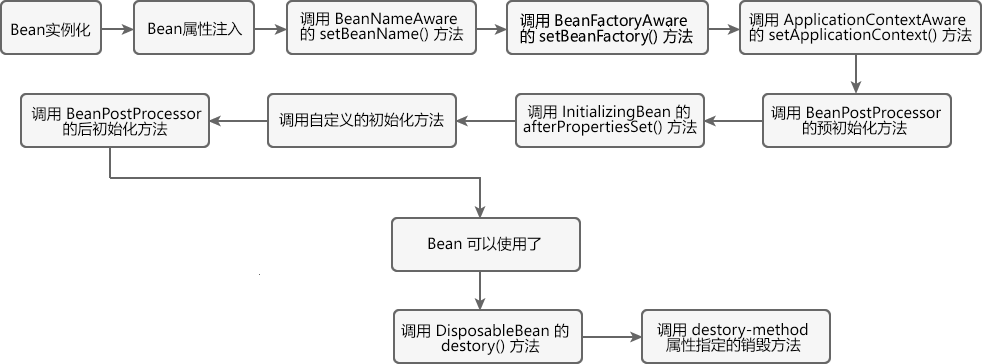
Bean 生命周期的整个执行过程描述如下。
- Spring 启动,查找并加载需要被 Spring 管理的 Bean,对 Bean 进行实例化。
- 对 Bean 进行属性注入。
- 如果 Bean 实现了
BeanNameAware接口,则 Spring 调用 Bean 的setBeanName()方法传入当前 Bean 的 id 值。 - 如果 Bean 实现了
BeanFactoryAware接口,则 Spring 调用setBeanFactory()方法传入当前工厂实例的引用。 - 如果 Bean 实现了
ApplicationContextAware接口,则 Spring 调用setApplicationContext()方法传入当前ApplicationContext实例的引用。 - 如果 Bean 实现了
BeanPostProcessor接口,则 Spring 调用该接口的预初始化方法postProcessBeforeInitialzation()对 Bean 进行加工操 作,此处非常重要,Spring 的 AOP 就是利用它实现的。 - 如果 Bean 实现了
InitializingBean接口,则 Spring 将调用 afterPropertiesSet() 方法。 - 如果在配置文件中通过
init-method属性指定了初始化方法,则调用该初始化方法。 - 如果
BeanPostProcessor和 Bean 关联,则 Spring 将调用该接口的初始化方法postProcessAfterInitialization()。此时,Bean 已经可以被应用系统使用了。 - 如果在
<bean>中指定了该 Bean 的作用域为singleton,则将该 Bean 放入 Spring IoC 的缓存池中,触发 Spring 对该 Bean 的生命周期管理; - 如果在
<bean>中指定了该 Bean 的作用域为prototype,则将该 Bean 交给调用者,调用者管理 该 Bean 的生命周期,Spring 不再管理该 Bean。 - 如果 Bean 实现了
DisposableBean接口,则 Spring 会调用destory()方法销毁 Bean; - 如果在配置文件中通过
destory-method属性指定了 Bean 的销毁方法,则 Spring 将调用该方法对 Bean 进行销毁。
自定义生命周期
Bean 的生命周期回调方法主要有两种:
- 初始化回调方法:在 Spring Bean 被初始化后调用,执行一些自定义的回调操作。
- 销毁回调方法:在 Spring Bean 被销毁前调用,执行一些自定义的回调操作。
我们可以通过以下 3 种方式自定义 Bean 的生命周期回调方法:
- 通过接口实现
- 通过 XML 配置实现
- 使用注解实现
如果一个 Bean 中有多种生命周期回调方法时,优先级顺序为:注解 > 接口 > XML 配置。
通过接口实现:
| 回调方式 | 接口 | 方法 | 说明 |
|---|---|---|---|
| 初始化回调 | InitializingBean | afterPropertiesSet() | 指定初始化回调方法,这个方法会在 Spring Bean 被初始化后被调用,执行一些自定义的回调操作。 |
| 销毁回调 | DisposableBean | destroy() | 指定销毁回调方法,这个方法会在 Spring Bean 被销毁前被调用,执行一些自定义的回调操作。 |
通过 XML 配置实现:
| XML 配置属性 | 描述 |
|---|---|
| init-method | 指定初始化回调方法,这个方法会在 Spring Bean 被初始化后被调用,执行一些自定义的回调操作。 |
| destory-method | 指定销毁回调方法,这个方法会在 Spring Bean 被销毁前被调用,执行一些自定义的回调操作。 |
使用注解实现:
| 注解 | 描述 |
|---|---|
| @PostConstruct | 指定初始化回调方法,这个方法会在 Spring Bean 被初始化后被调用,执行一些自定义的回调操作。 |
| @PreDestroy | 指定销毁回调方法,这个方法会在 Spring Bean 被销毁前被调用,执行一些自定义的回调操作。 |
后置处理器
BeanPostProcessor 接口也被称为后置处理器,通过该接口可以自定义调用初始化前后执行的操作方法。
BeanPostProcessor 接口源码如下:
public interface BeanPostProcessor {
    Object postProcessBeforeInitialization(Object bean, String beanName)
      throws BeansException;

    Object postProcessAfterInitialization(Object bean, String beanName)
      throws BeansException;
}
该接口中包含了两个方法:
- postProcessBeforeInitialization() 方法:在 Bean 实例化、属性注入后,初始化前调用。
- postProcessAfterInitialization() 方法:在 Bean 实例化、属性注入、初始化都完成后调用。
注:方法返回值不能为 null,否则会报空指针异常或者通过 getBean() 方法获取不到 Bean 实例对象。
创建bean的后置处理器:
package cc.taketo.process;

import org.springframework.beans.BeansException;
import org.springframework.beans.factory.config.BeanPostProcessor;

public class MyBeanProcessor implements BeanPostProcessor {

    @Override
    public Object postProcessBeforeInitialization(Object bean, String beanName) throws BeansException {
        System.out.println("☆☆☆" + beanName + " = " + bean);
        return bean;
    }

    @Override
    public Object postProcessAfterInitialization(Object bean, String beanName) throws BeansException {
        System.out.println("★★★" + beanName + " = " + bean);
        return bean;
    }
}
在IOC容器中配置后置处理器:
<!-- bean的后置处理器要放入IOC容器才能生效 -->
<bean id="myBeanProcessor" class="cc.taketo.process.MyBeanProcessor"/>
当需要添加多个后置处理器实现类时:
默认情况下 Spring 容器会根据后置处理器的定义顺序来依次调用。也可以通过实现 Ordered 接口的 getOrder 方法指定后置处理器的执行顺序。
该方法返回值为整数,默认值为 0,取值越大优先级越低。
package cc.taketo.process;

import org.springframework.beans.BeansException;
import org.springframework.beans.factory.config.BeanPostProcessor;
import org.springframework.core.Ordered;

public class MyBeanProcessor implements BeanPostProcessor, Ordered {

    @Override
    public Object postProcessBeforeInitialization(Object bean, String beanName) throws BeansException {
        System.out.println("☆☆☆" + beanName + " = " + bean);
        return bean;
    }

    @Override
    public Object postProcessAfterInitialization(Object bean, String beanName) throws BeansException {
        System.out.println("★★★" + beanName + " = " + bean);
        return bean;
    }

    @Override
    public int getOrder() {
        return 0;
    }
}
FactoryBean
FactoryBean是Spring提供的一种整合第三方框架的常用机制。和普通的bean不同,配置一个FactoryBean类型的bean,在获取bean的时候得到的并不是class属性中配置的这个类的对象,而是getObject()方法的返回值。通过这种机制,Spring可以帮我们把复杂组件创建的详细过程和繁琐细节都屏蔽起来,只把最简洁的使用界面展示给我们。
将来我们整合Mybatis时,Spring就是通过FactoryBean机制来帮我们创建SqlSessionFactory对象的。
/*
 * Copyright 2002-2020 the original author or authors.
 *
 * Licensed under the Apache License, Version 2.0 (the "License");
 * you may not use this file except in compliance with the License.
 * You may obtain a copy of the License at
 *
 *      https://www.apache.org/licenses/LICENSE-2.0
 *
 * Unless required by applicable law or agreed to in writing, software
 * distributed under the License is distributed on an "AS IS" BASIS,
 * WITHOUT WARRANTIES OR CONDITIONS OF ANY KIND, either express or implied.
 * See the License for the specific language governing permissions and
 * limitations under the License.
 */
package org.springframework.beans.factory;

import org.springframework.lang.Nullable;

/**
 * Interface to be implemented by objects used within a {@link BeanFactory} which
 * are themselves factories for individual objects. If a bean implements this
 * interface, it is used as a factory for an object to expose, not directly as a
 * bean instance that will be exposed itself.
 *
 * <p><b>NB: A bean that implements this interface cannot be used as a normal bean.</b>
 * A FactoryBean is defined in a bean style, but the object exposed for bean
 * references ({@link #getObject()}) is always the object that it creates.
 *
 * <p>FactoryBeans can support singletons and prototypes, and can either create
 * objects lazily on demand or eagerly on startup. The {@link SmartFactoryBean}
 * interface allows for exposing more fine-grained behavioral metadata.
 *
 * <p>This interface is heavily used within the framework itself, for example for
 * the AOP {@link org.springframework.aop.framework.ProxyFactoryBean} or the
 * {@link org.springframework.jndi.JndiObjectFactoryBean}. It can be used for
 * custom components as well; however, this is only common for infrastructure code.
 *
 * <p><b>{@code FactoryBean} is a programmatic contract. Implementations are not
 * supposed to rely on annotation-driven injection or other reflective facilities.</b>
 * {@link #getObjectType()} {@link #getObject()} invocations may arrive early in the
 * bootstrap process, even ahead of any post-processor setup. If you need access to
 * other beans, implement {@link BeanFactoryAware} and obtain them programmatically.
 *
 * <p><b>The container is only responsible for managing the lifecycle of the FactoryBean
 * instance, not the lifecycle of the objects created by the FactoryBean.</b> Therefore,
 * a destroy method on an exposed bean object (such as {@link java.io.Closeable#close()}
 * will <i>not</i> be called automatically. Instead, a FactoryBean should implement
 * {@link DisposableBean} and delegate any such close call to the underlying object.
 *
 * <p>Finally, FactoryBean objects participate in the containing BeanFactory's
 * synchronization of bean creation. There is usually no need for internal
 * synchronization other than for purposes of lazy initialization within the
 * FactoryBean itself (or the like).
 *
 * @author Rod Johnson
 * @author Juergen Hoeller
 * @since 08.03.2003
 * @param <T> the bean type
 * @see org.springframework.beans.factory.BeanFactory
 * @see org.springframework.aop.framework.ProxyFactoryBean
 * @see org.springframework.jndi.JndiObjectFactoryBean
 */
public interface FactoryBean<T> {

    /**
     * The name of an attribute that can be
     * {@link org.springframework.core.AttributeAccessor#setAttribute set} on a
     * {@link org.springframework.beans.factory.config.BeanDefinition} so that
     * factory beans can signal their object type when it can't be deduced from
     * the factory bean class.
     * @since 5.2
     */
    String OBJECT_TYPE_ATTRIBUTE = "factoryBeanObjectType";

    /**
     * Return an instance (possibly shared or independent) of the object
     * managed by this factory.
     * <p>As with a {@link BeanFactory}, this allows support for both the
     * Singleton and Prototype design pattern.
     * <p>If this FactoryBean is not fully initialized yet at the time of
     * the call (for example because it is involved in a circular reference),
     * throw a corresponding {@link FactoryBeanNotInitializedException}.
     * <p>As of Spring 2.0, FactoryBeans are allowed to return {@code null}
     * objects. The factory will consider this as normal value to be used; it
     * will not throw a FactoryBeanNotInitializedException in this case anymore.
     * FactoryBean implementations are encouraged to throw
     * FactoryBeanNotInitializedException themselves now, as appropriate.
     * @return an instance of the bean (can be {@code null})
     * @throws Exception in case of creation errors
     * @see FactoryBeanNotInitializedException
     */
    @Nullable
    T getObject() throws Exception;

    /**
     * Return the type of object that this FactoryBean creates,
     * or {@code null} if not known in advance.
     * <p>This allows one to check for specific types of beans without
     * instantiating objects, for example on autowiring.
     * <p>In the case of implementations that are creating a singleton object,
     * this method should try to avoid singleton creation as far as possible;
     * it should rather estimate the type in advance.
     * For prototypes, returning a meaningful type here is advisable too.
     * <p>This method can be called <i>before</i> this FactoryBean has
     * been fully initialized. It must not rely on state created during
     * initialization; of course, it can still use such state if available.
     * <p><b>NOTE:</b> Autowiring will simply ignore FactoryBeans that return
     * {@code null} here. Therefore it is highly recommended to implement
     * this method properly, using the current state of the FactoryBean.
     * @return the type of object that this FactoryBean creates,
     * or {@code null} if not known at the time of the call
     * @see ListableBeanFactory#getBeansOfType
     */
    @Nullable
    Class<?> getObjectType();

    /**
     * Is the object managed by this factory a singleton? That is,
     * will {@link #getObject()} always return the same object
     * (a reference that can be cached)?
     * <p><b>NOTE:</b> If a FactoryBean indicates to hold a singleton object,
     * the object returned from {@code getObject()} might get cached
     * by the owning BeanFactory. Hence, do not return {@code true}
     * unless the FactoryBean always exposes the same reference.
     * <p>The singleton status of the FactoryBean itself will generally
     * be provided by the owning BeanFactory; usually, it has to be
     * defined as singleton there.
     * <p><b>NOTE:</b> This method returning {@code false} does not
     * necessarily indicate that returned objects are independent instances.
     * An implementation of the extended {@link SmartFactoryBean} interface
     * may explicitly indicate independent instances through its
     * {@link SmartFactoryBean#isPrototype()} method. Plain {@link FactoryBean}
     * implementations which do not implement this extended interface are
     * simply assumed to always return independent instances if the
     * {@code isSingleton()} implementation returns {@code false}.
     * <p>The default implementation returns {@code true}, since a
     * {@code FactoryBean} typically manages a singleton instance.
     * @return whether the exposed object is a singleton
     * @see #getObject()
     * @see SmartFactoryBean#isPrototype()
     */
    default boolean isSingleton() {
        return true;
    }
}
创建类UserFactoryBean
public class UserFactoryBean implements FactoryBean<User> {
    @Override
    public User getObject() throws Exception {
        return new User();
    }

    @Override
    public Class<?> getObjectType() {
        return User.class;
    }
}
配置bean
<bean id="user" class="cc.taketo.bean.UserFactoryBean"></bean>测试
@Test
public void testUserFactoryBean(){
    //获取IOC容器
    ApplicationContext ac = new ClassPathXmlApplicationContext("spring-factorybean.xml");
    User user = (User) ac.getBean("user");
    System.out.println(user);
}